Jaded from Jasper Peak
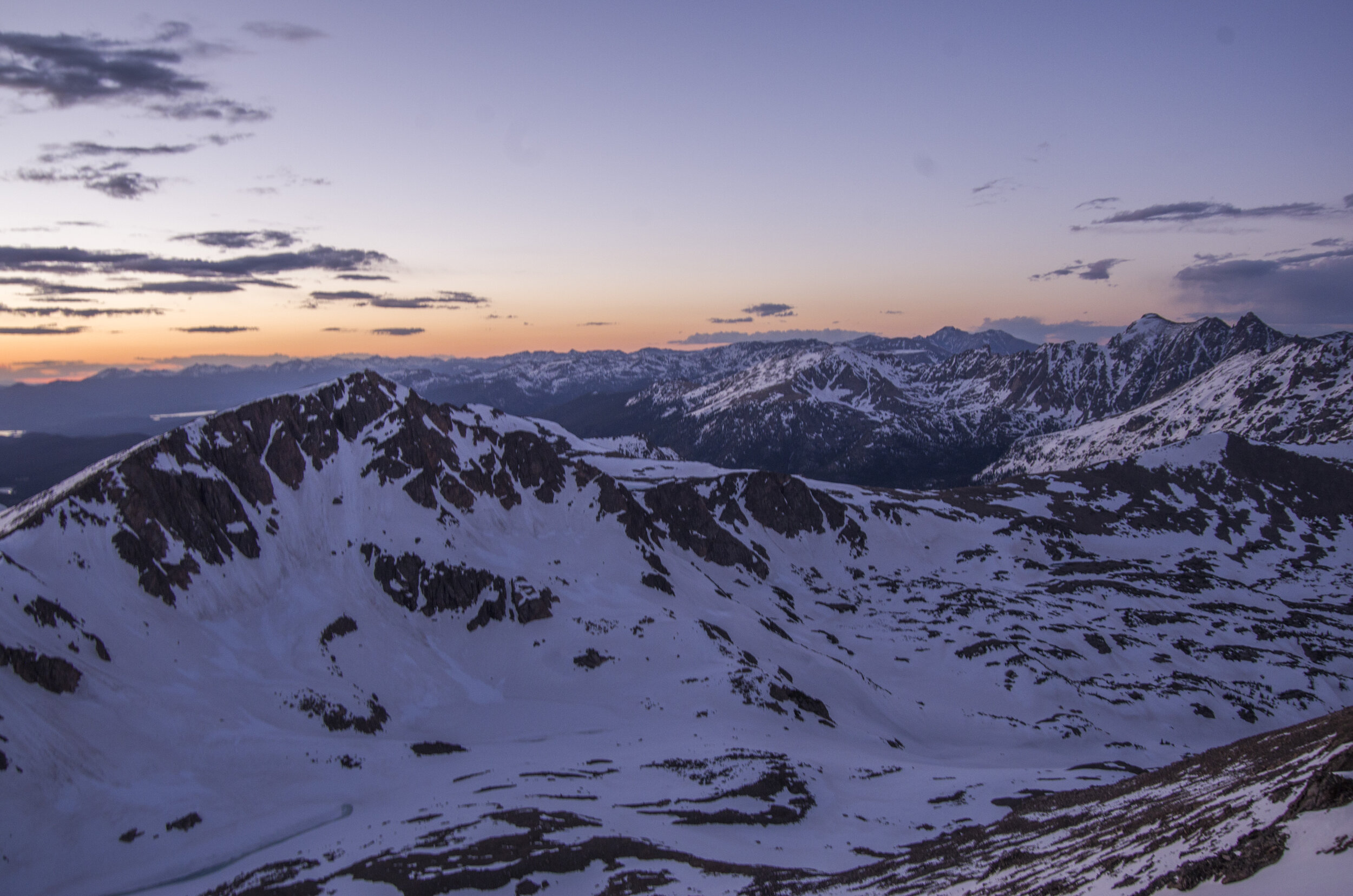
Blue Hour from the Summit of Jasper Peak
Today I share a story from my first season of ski touring. I had a near-miss incident skiing Jasper Peak. It’s about a lot more than the incident, of course. It’s 1/4 incident report, 1/4 case study of human factors, and probably 1/2 discussion of a stress injury that gets pretty intimate and personal about my relationship with skiing and how this event and the season it happened affected me. As I continue to process and mentally recover from my climbing accident last fall, I realize the power that this season and incident has held over me for years. So I want to share, because it’s an integral part of my recovery and moving forward into a more positive relationship with myself and my mountain sports.
“So I think I’m going to ski Jasper peak with Matt* after work tomorrow.” “Okay, great,” I responded, and then after a moment’s pause - “do you think I could come?” This had been my first season in the sport of backcountry skiing, and I was loving it. I had loved skiing, fitness, and being in the mountains already, and this sport really brought it all together for me in a special way. I was anxious to go any time I possibly could. (*name change)
Since buying my first touring setup in early February, I had already iterated through three pairs of touring boots, woken up at 4am for countless dawn patrols, and skied 2.5 spring 14er lines. All these backcountry days had been shared with the same partner, a respectably seasoned backcountry enthusiast who I was also dating. Our relationship, and my relationship with backcountry skiing, were not caused by one another, but coincidentally started at the same time. Nonetheless, this partner was the only mentor figure I had in the sport, and in addition to being my partner for all of my backcountry days, he also taught me everything I knew up to this point about avalanches and risk tolerance.
“Well…it’s kind of steep. Here, take a look.” A page on the PowderProject app was handed to me. I looked at it, but it pretty much meant nothing to me. “How does it compare to Elbert?” I asked. We had skied the Box Creek Couloir a couple weeks ago - it was one of my few points of reference. “About the same.” I shrugged. “Okay, sounds good - I feel like I’ll be fine then.” “Okay - Matt says he is fine with you coming. We’ll probably leave town around 2:30.”
And leave town around 2:30 the next day we did. It was sunny and warm at the trailhead, typical of the late May Boulder weather, and I wore spandex leggings instead of my usual heavy skiing pants. I didn’t have all the fancy ‘Boulderite’ gear back then. We put on our hiking shoes and strapped our skis to our packs. We started up the trail. The approach to Jasper took longer than expected. Between route-finding, bushwhacking, and variable snow conditions, it took us a while to get through the drainage and near to Jasper Peak. My partner pointed to a line to the side of what I intended to ski. “I think I’m gonna ski that - it’s a steeper and harder line.” “Okay.” I had no interest, but it didn’t really affect me as long as he was fine. This was pretty typical. We passed an old avalanche debris field, and gave a school bus sized cornice a wide berth. I was worried about keeping up, but my pace was fine and I needn’t have worried. By the time we took our skis off again to boot up the steepest part of the Jasper face, it was just about sunset and the corn snow we hoped to ski was already starting to turn back to ice. We pressed on, without verbal observation. I stayed on Matt’s tail up the boot pack, determined to prove to my partner I wasn’t a weak link. When we topped out, the sun had set and we transitioned in the blue hour.
Matt dropped first. His tele setup shattered on the ice as he traversed across the bowl instead of turning smoothly down. My headlamp flickered, it wasn’t working properly. A wave of fear and apprehension flickered over me. Wow, I really didn’t want to ski that. I didn’t know if I could ski that. Yikes. I knew the light was fading quickly and I had to drop. It was only getting icier and darker from here. My partner encouraged me to go, noting these same thoughts. I took a deep breath and sideslipped into the bowl. My skis did not catch much of an edge. There was no chance I was turning here. I visualized myself falling down the steep, 1000ft bowl. It was a real threat, made significantly worse by the visualization. I stopped. The pressure to ski and fear mounted rapidly - as well as the pressure of taking my partner’s chance to ski his line away from him. I couldn’t control my emotions and I started to cry. Slowly, with my partner following closely behind, I sidestepped my way down the entire bowl, feeling more and more shame as I continued to descend.
The rest of the de-proach should have been easy. Even easy skiing on perfect snow was suddenly traumatic though. My body was cold, and exhausted, as was my mind. I should have ate more snacks on the approach, but I didn’t want to stop to do that for fear of being seen as weak and slow, and now I was passed the point of hunger. I fell and cried multiple times. I felt shame, and guilt, and awfulness. I should have been able to ski that. It shouldn’t have been such a big deal. Neither should getting back to the car be. Wow, I suck. It was a slippery, spirally slope for me to get back to the parking lot that night.
Once at the car, I crawled into my tiny backseat and handed the keys to my partner. It was nearly midnight from my recollection. I didn’t want to enjoy a beer with them, I didn’t deserve it. I felt horrible. I wasn’t sure if I’d ever felt that horrible before.
My partner and I didn’t discuss what happened after much. The feedback I did get was that I had invited myself and I wasn’t really invited, and that my partner was concerned to ski with me going forward. I wasn’t ready, I didn’t have any skills. I took all the blame and guilt about the incident on my shoulders even more - how could I have been so negligent to make choices to expose all of us to that situation and that risk? How did I let myself handle my emotions so poorly? I should have known better, I should have been better. Hell, I should have known better than to be there.
In objective regards to my role in the incident, I don’t think I had much business doing an after work ski tour of Jasper peak that day. I didn’t have a map, or any idea of the route or trip plan, and that disqualifies me now in my book. But with the context that I had about ski touring, I’m sure I made the best choice I could. From what I knew then, I had the ability, I was invited, and I wanted to ski. As the leader, if my partner felt otherwise, he had every right to say this and absolutely should have.
I’m not proud of how I handled the stress of that situation, either. I would always rather not have a breakdown and handle the situation with grace. But I realize the stress of the day was the culmination of other dynamics in the [skiing] partnership. I was constantly trying to keep up and be good enough. I was new to the sport, I was ambitious and competitive, it was natural. But I’ve since learned that isn’t how a good partnership feels. Yeah, one person might be stronger and the leader, but a good partner doesn’t make you feel lesser and like you have to keep proving yourself to eventually earn the title of partner. They treat you as an integral part of the team, and that it’s ok to have weaknesses and vulnerabilities. In fact, the trust to share that is one of the key points of partnership (to me). And to be fair, mentorship is a different kind of relationship than partnership, and maybe in this context, that relationship would be more appropriate. The same interpersonal dynamics apply, and this was neither. But I also need to work on my communication.
There should have been a very different debrief after the day. What went wrong, what could have been done better, how we move forward. It wouldn’t have solved all the problems. But it should have happened.
With no debrief and the partner dynamics as they were, the ideas of ‘I’m not good enough, I can’t make good decisions in the backcountry, I’m not a good partner, I don’t deserve to be out here,’ took deep roots in my mind. Worse probably, because they were intertwined in the dynamics of the relationship beyond skiing. These beliefs affected my capacity to enjoy skiing and enjoy new ski partners
I carried those thoughts and feelings and shame and guilt around with me unknowingly for a long time. Months, years, after, I would go skiing and nearly break down, in situations that didn’t really warrant it, but usually when something didn’t go exactly as planned or I couldn’t control everything. Sometimes I actually did break down. In other situations I would talk about a near miss I had on Jasper peak, and how it had been my fault to make the poor decisions that got me there. I never connected the two items. I’d also talk and sort of joke about how I had a ‘stress injury’ from skiing, but I was never really serious about it. I didn’t deserve to have that from such a stupid incident. But in most situations, both in and out of bounds, the reality was that skiing was less fun. The reality was when I got home, I didn’t feel tired yet recharged from a fun day. I felt tired and down.
Perhaps, there were some clues. I felt the same wave of absolute horribleness I’d felt after that descent of Jasper after my first day of downhill ski patrol this season. Another time, there was a nice powder day at Eldora the year after the incident where I literally let myself tumble down the hill instead of skiing. I spent the rest of the day in the lodge, sleeping on a bench - my friends were concerned but I didn’t know what to tell them. I guess I just…didn’t like to ski? Had the flu? After ski patrol, when I got home, I was so dysfunctional, I basically shut down. I couldn’t interact with anyone in the house. I couldn’t speak without crying. Eventually, I had to abandon the dinner I knew I needed to choke down and go lie down in the dark. I didn’t realize until months after, though, when I tried the EMDR floatback technique, what I was reliving. I didn’t like downhill ski patrol, and that was fine, but it was confusing and embarrassing that it was so triggering for me when it had objectively just been a rather pedantic and long day of skiing laps on blue groomers. On the other hand, I spent most of that long day feeling pretty un-empowered and useless due to lack of organization. This coupled with skiing makes sense that it would cause the feelings that I’d put away, unprocessed, to flood back.
So finally making that connection this year was huge. Awareness is power. But the truth is also, in my experience with trauma, that it’s never just the one event. It’s also what happens before and after the event, and how that integrates with you.
My perspective on ski touring was shaped by a single partner, who I was also romantically involved with. After the incident, stuff never felt quite right. And based on how we (didn’t) talked about it after, I’m not sure how it could have.
I’d be lying if I said there wasn’t days after the incident I went out skiing or climbing with other partners and treated them the same way I’d been treated. In a way, it was all I knew. It was a toxic cycle.
Understanding that while I don’t love the choices I made and would not make them now, that I really did make the best choices with the information and context I had, has helped me begin to move forward from this and integrate. That knowing while I could have handled the situation better, the dynamics were not all my fault and were complex to see at the time because they had been building for a while. It is now an event of learning, not of personal shame and failure that should prevent me from ever skiing with full joy again for the rest of my life as punishment. I’ve found a lot of personal forgiveness.
But if I felt so horrible skiing all these years, why did I keep doing it?
Well, I used to love skiing - from the first day I skied Bridger Bowl on my K2 Sweet Luv skis, I knew I was a skier. I was convinced I just needed to force myself to keep doing it to find the joy again. I still kind of am. I don’t like skiing right now, but I still love it, I felt.
Maybe there were some other factors, too. The idea of the narrow perspective of having a singular skiing partner affected my identity with the sport. I felt the way he ski toured was the only way to enjoy ski touring - having it be a point of identity where you skied always, as much as possible, like your identity, happiness, and existence depended on it. When this partnership ended, I started skiing all the time because I thought I had to to be a real skier, and with the aforementioned thoughts in my head, I started to really hate it. There were almost no positive thoughts related to skiing in my head at this point, yet it was something I had to do. I loved skiing, I would be a skier. Within a few months, I started skiing a lot less.
Furthering the notion of how this narrow perspective affected me, skiing with one partner, including taking my Avalanche 1 from him instead of a professional, I hadn’t had the opportunity to develop my own risk tolerance. It’s taken me years to understand that, as well. That when the slope is icing over past the corn cycle, I don’t care about getting to the summit because everyone else seems to want to, I want to speak up and get down. And also, that I don’t want to mess around with wet slides - but that’s a different story. Like I said, it’s never just a single incident really.
While I’ve struggled to like skiing over the last few years, I’ve also invested in education by professionals (because I still think I love skiing) as well as time applying the tools learned and I feel empowered that since then, I’ve learned to speak up, and also build and follow my own trip plans. I honestly still find partnerships difficult, and I suspect that is one of the keys to getting that word ‘like’ back.
BUT…and here’s the big but…even after all these realizations, skiing is still tough many days. While this is the best season I’ve had since the incident, I still often get back to the house and feel down instead of up. After having this initial realization, I had a few glorious days of turns where I felt like my old self and had got it back. That wasn’t a sustainable feeling though, and it’s taken a lot of days of not skiing because I’m not feeling it to slowly start to realize I actually want to do it again. It’s also taken a lot of other work that I’m not ready to write about. Slowly, it seems to be paying off - this season I had one of my best ski weekends ever - skiing uphill and also riding chairlifts in Aspen - surrounded by a group of motivated women which is a definite pattern shift for me. But then again, a day and a halflater I was skiing around Boulder after a heavy snow and having much less fun than I felt I was ‘supposed’ to have. I still haven’t figured out quite how to heal this stress injury or how long that takes, but I have made noticeable progress and I think I am on a path finally.
I’ll be damned if I’m not going to get through this and enjoy those fluffy turns again. Maybe it’s stupid and silly and stubborn and a breakup that should have happened years ago, but I’m convinced at my core, I still love skiing.